
Practice Management
 Practice Management
Retirement Tax Bill: Start the Conversation
A practical retire-tax-bill.com walkthrough with opening questions, curiosity hooks and client conversations

Bryan Daly, CFP®, RICP®
For insurance agents and financial advisors
“My IRA is creating a tax problem. Where do we start?”
When a client asks this, what do you ask first? This free sample lesson shows how Bryan leads the conversation with better questions.
01
Ask first
Open with the client’s income goal—not a product or a tax number.
02
Spark curiosity
Use the walkthrough to show what IRA withdrawals could mean after taxes.
03
Compare options
Explain choices in plain English, including making no change.
Free sample lesson · No account needed
Live training: Every Saturday · 10 a.m. Eastern
Lesson at a glance
What each section covers
01
60-minute training agenda
- Timed blocks from opening to role-play
- Each block ends with a practice outcome
02
Site walkthrough: Calculate → Evaluate → Act
- What to enter on retire-tax-bill.com
- What to say and check at each step
03
Read the report
- What each label and assumption means
- Limits to mention before discussing results
04
Opening questions
- Questions that invite a real conversation
- A natural follow-up for each one
05
Curiosity hooks
- Connect the tax gap to the client’s goal
- Avoid fear-based or misleading versions
06
Hypothetical arithmetic
- Simple balance × rate practice cases
- Clearly separate from the website report
07
Turn examples into conversations
- Talking point and question per prospect
- How to earn the next step
08
Compelling talking points
- Say it simply and explain why it matters
- Pair each point with its qualification
09
Respond to objections
- Helpful responses without pushing
- A next question to keep talking
10
Before making a recommendation
- Facts to confirm in each review area
- What not to assume
11
Slides: How Income Tax Is Calculated
- 13 slides from income to AGI, deductions and brackets
- Senior deduction, planning room and tax planning vs. tax advice
Use curiosity—not fear or a promise of savings
Adviser training and role-play material, not a client-specific recommendation, approved advertisement or continuing-education credit. Adapt client-facing scripts to your firm’s review requirements. No tax liability, savings, tax-free income, investment return or product outcome is guaranteed; coordinate individualized analysis with the client’s tax professional.
Reviewed November 2, 2026. The live first two steps were checked with fictional numbers without submitting contact information. The public calculator code was also reviewed to explain its assumptions and report labels. Report submission, final results in a submitted session and email delivery were not tested. The walkthrough distinguishes live observations from source-reviewed report details.
The site requests first name, last name and email; phone is optional. Its submission notice says New Life Financial Planning may contact the user about results and warns against entering account or Social Security numbers. Its disclosure notes possible insurance-agent contact and insurance-sale commissions. Explain this before asking a client to submit; do not describe the report as anonymous or contact-free.
The site models a potential tax impact through age 90 under fixed assumptions. A projected total is not a current IRS debt, a complete household forecast or proven savings. Its “Reposition to a tax-free account today” comparison is a simplified alternative—not an approved product recommendation or proof that full repositioning is suitable.
The separate arithmetic examples below are one-time balance × assumed-rate illustrations, not the site’s age-90 report. Account basis, future withdrawals, income, deductions, state law, costs and future rates matter. Do not label an assumed tax difference as guaranteed savings.
Free sample lesson · No account required
Problem first: “What could your savings provide after taxes?” Not product first: “You should convert everything.” Compare alternatives—including no change—after understanding the client’s goals and facts.
Your lesson at a glance
Who it is for
Agents and advisors practicing a permission-based retirement-tax conversation.
Video length
Written lesson · No video recording. The 60-minute agenda is workshop time, not video length.
What you will learn
- Open with the client’s income goal rather than a product.
- Explain calculator assumptions without calling an estimate a tax bill.
- Agree on an optional next review with the client and tax professional.
Case example · Training practice
Maria wants clarity—not a product pitch
In the existing fictional Maria case, a 60-year-old client asks how her retirement savings could support spending after taxes. Before using a calculator, uncover what she wants the review to answer.
- What would you ask before discussing account changes?
- What is known, and what is only an assumption?
- How would you explain a comparison that includes leaving things unchanged?
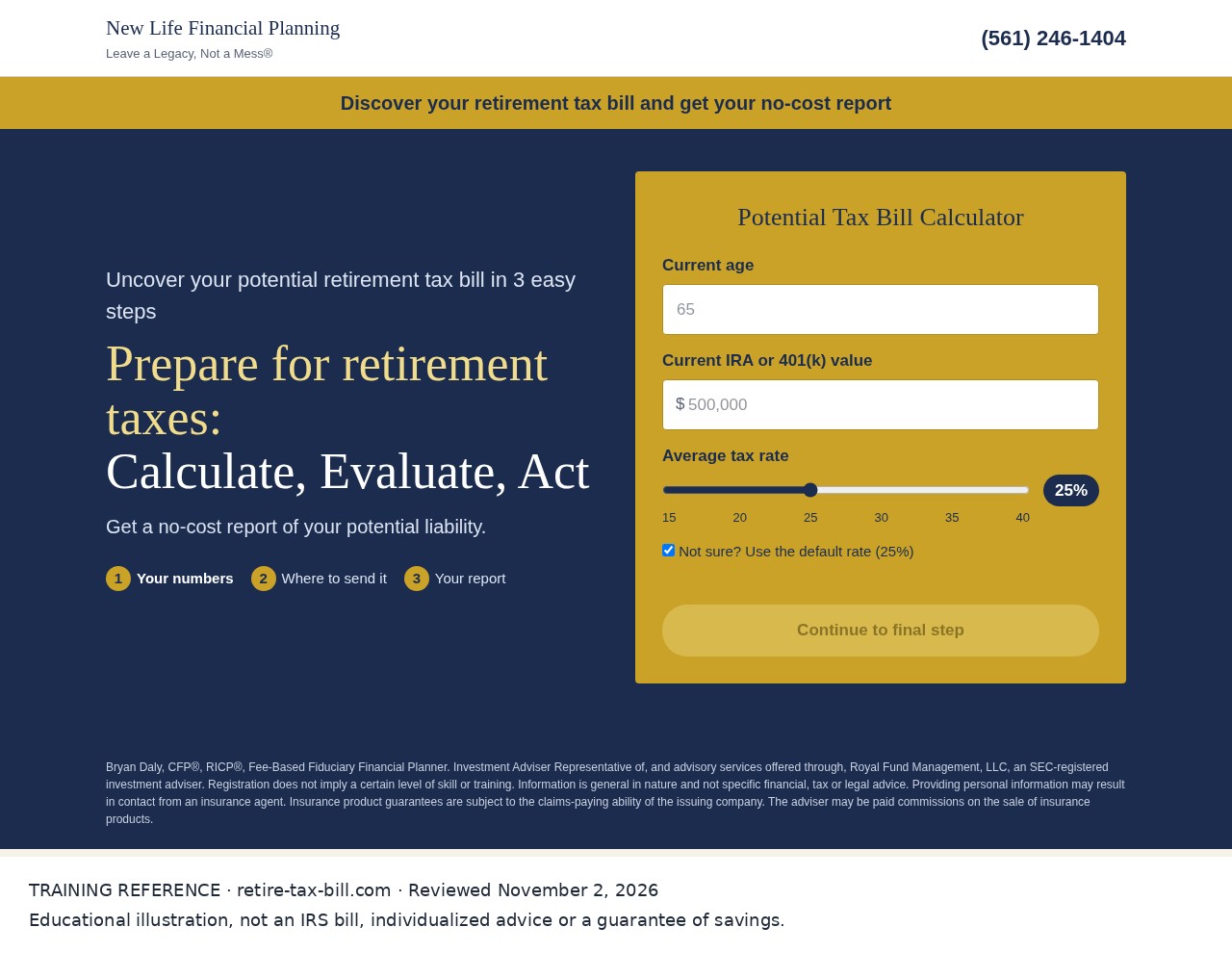
Practice with the site
Open retirement tax calculatorLesson resources
Download conversation training & facilitator notesDownload How Income Tax Is Calculated slides (PowerPoint)Objective
Lead a permission-based discovery conversation, demonstrate the site accurately, explain the report’s assumptions and limits, and earn a specific next appointment to review after-tax retirement choices—not to sell a predetermined solution.
Key messages
The calculator is a conversation starter, not the financial plan. Help a prospect connect an account balance with retirement income after taxes, then discover which assumptions and decisions deserve attention.
Use this sequence: ask about a goal → ask permission → demonstrate with rounded or fictional numbers → discuss assumptions and the prospect’s reaction → agree on one useful next step. Ask one question at a time, listen and avoid turning discovery into an interrogation.
Lead with a relatable gap: “You know what your account is worth. Have you looked at what it could provide after taxes?” That contrast creates curiosity without claiming the government owns a fixed share of the account or the prospect has made a mistake.
The 25% default is not the client’s actual tax rate. The site calls it an average tax rate, not a marginal bracket. Use it only as a labeled hypothetical assumption; a tax professional should help establish suitable scenarios. The model holds its tax rate constant, which is different from applying actual progressive brackets each year.
Success means the prospect can explain the assumptions and chooses whether to continue. A large estimate does not justify rushing, moving an account, buying insurance or converting an entire IRA. A small estimate also does not prove no planning is needed.
Slide 1 of 13
How Income Tax Is Calculated
Purpose: give advisors a clean, accurate way to walk a retired couple from income to taxable income, spot planning room, and stay on the right side of the tax-planning vs. tax-advice line. Teaching flow: Concept > Why It Matters > Client Example > Advisor Script > Common Mistakes > Action Steps.
Slide 2 of 13
What You'll Be Able to Do
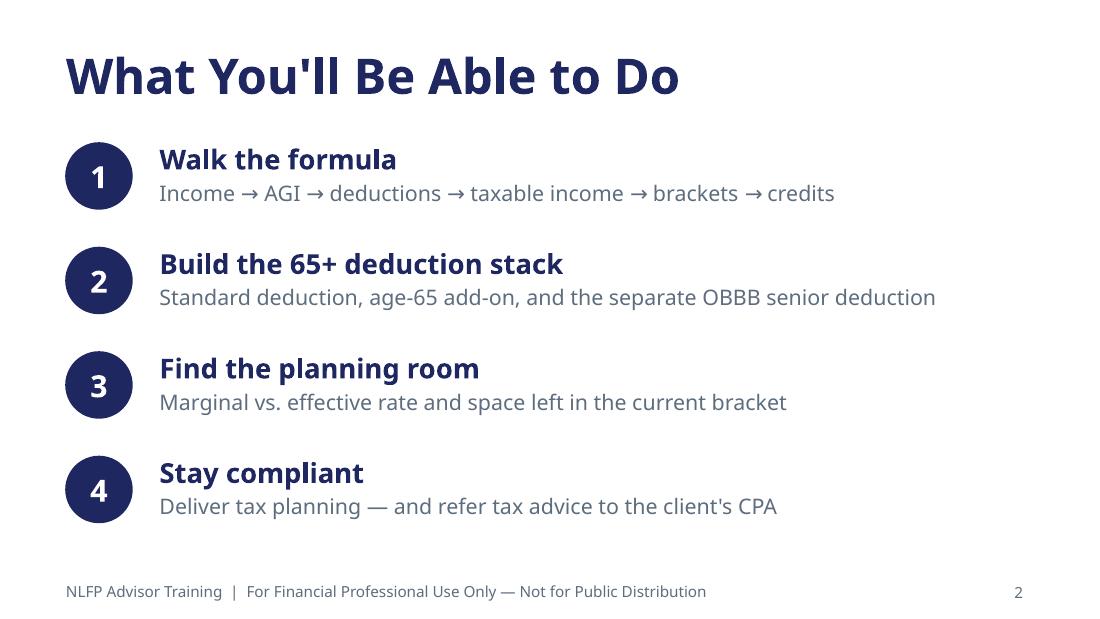
Set expectations: by the end, every advisor should be able to sketch this on a whiteboard in front of a client in under two minutes, without giving tax advice.
Slide 3 of 13
The Formula on One Page
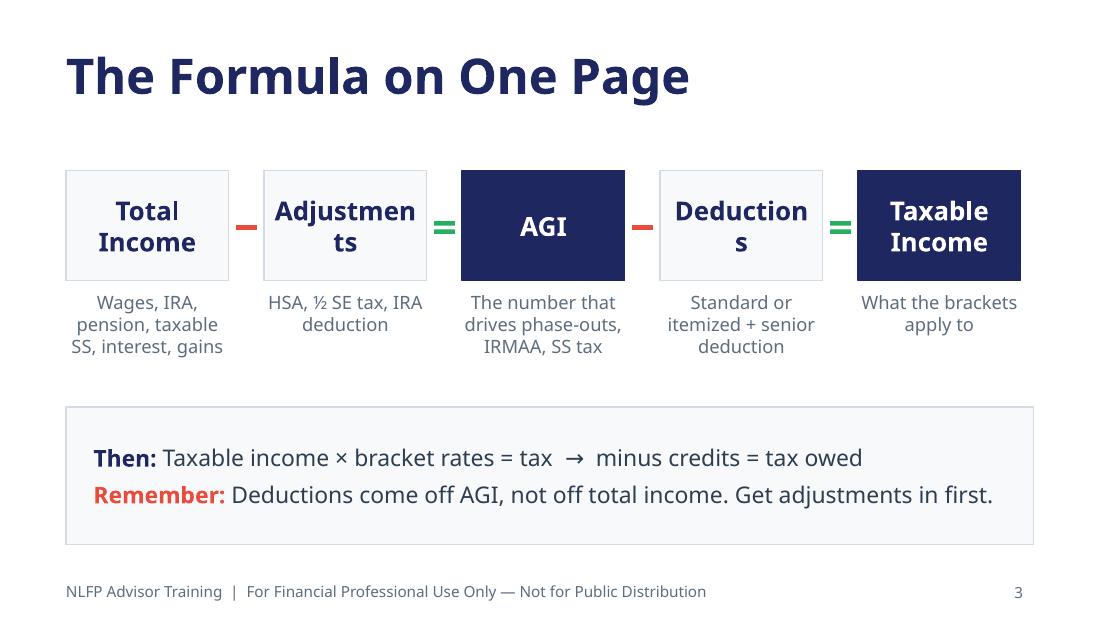
Form 1040 order: line 9 total income, line 10 adjustments, line 11 AGI, line 12 standard/itemized deduction, line 13b the new Schedule 1-A deductions (including the senior deduction), line 15 taxable income. Emphasize AGI/MAGI: it is the dial that controls the senior-deduction phase-out, IRMAA, and how much Social Security is taxable.
Slide 4 of 13
From AGI to Taxable Income
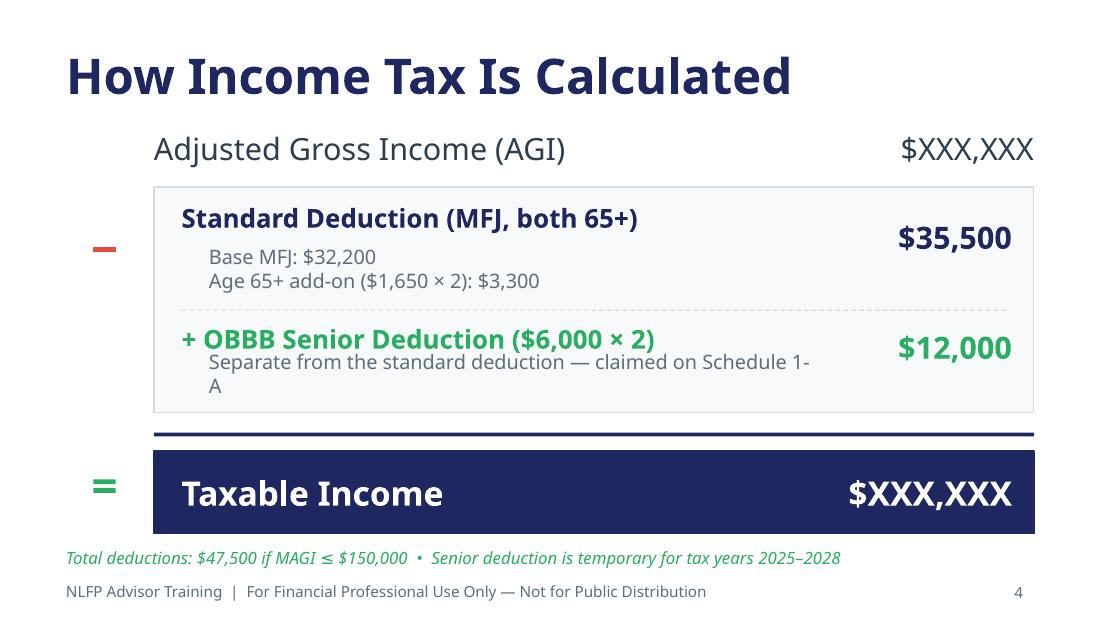
This is the original slide, corrected in two places: (1) the line starts from AGI, not total income; (2) the $12,000 senior deduction is shown as its own line, not as part of the standard deduction. The $47,500 total is right only when MAGI is at or below $150,000 and both spouses are 65+ by 12/31/2026 with valid SSNs.
Slide 5 of 13
The Senior Deduction: Rules and Phase-Out
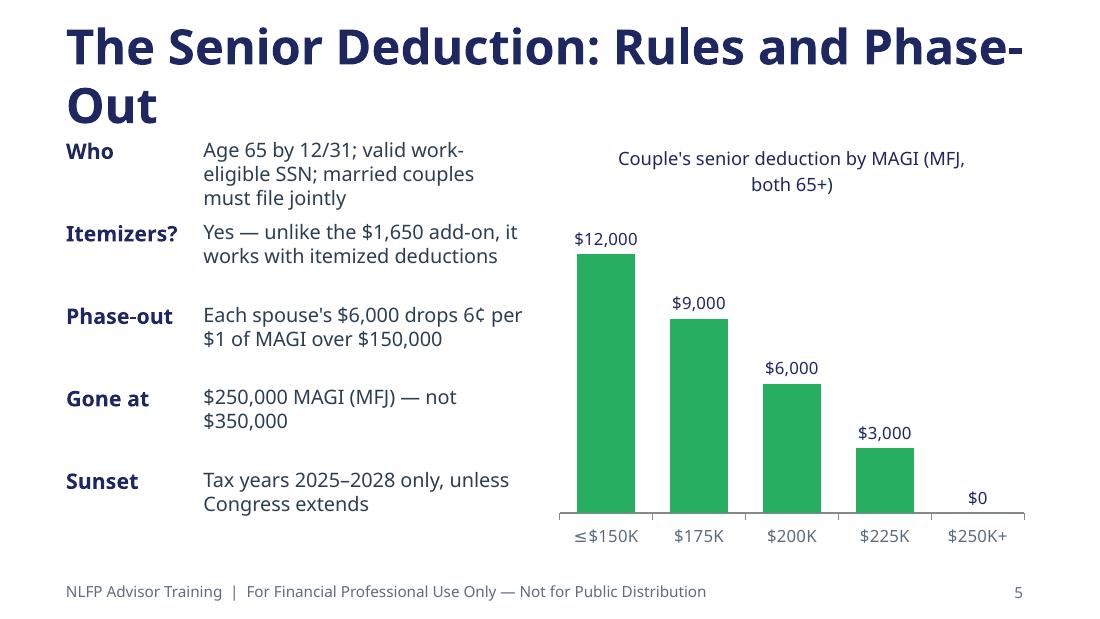
Per IRS Schedule 1-A Part V, the 6% reduction is applied separately to each spouse's $6,000 using the same joint MAGI, so both reach zero at $250,000. Some articles say $350,000 — that is wrong per the form. Practical effect: between $150K and $250K MAGI each extra dollar adds $0.12 of taxable income on top of itself — a hidden marginal-rate bump (1.12x).
Slide 6 of 13
2026 Brackets: Married Filing Jointly
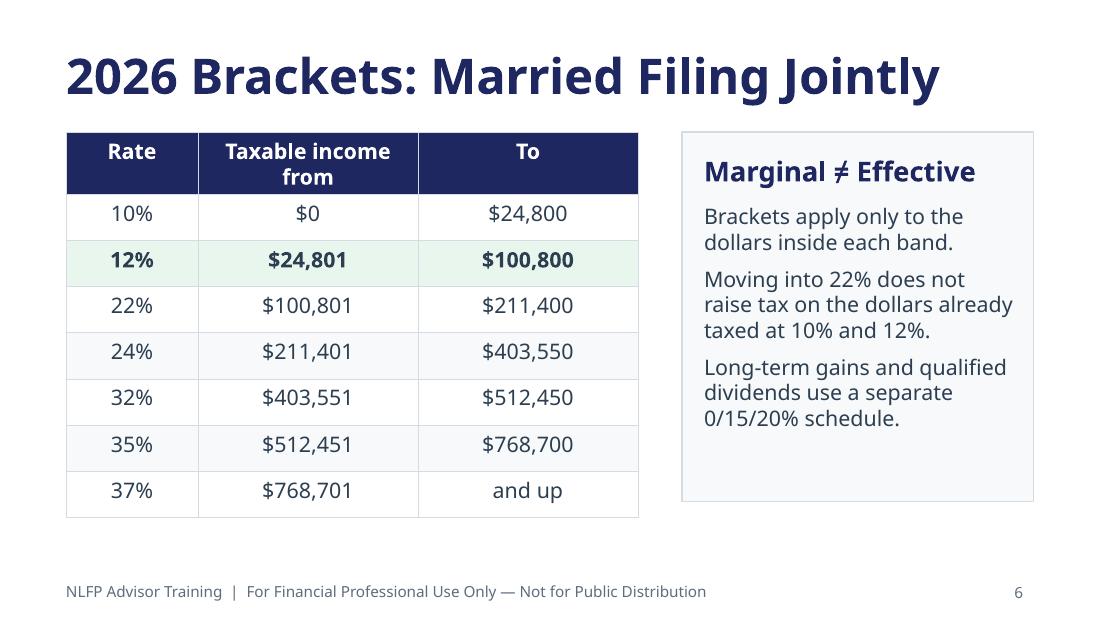
Source: IRS Rev. Proc. 2025-32. The 12% band is highlighted because that's where most of our middle-income retired couples live after the $47,500 deduction stack. Correct the 'I don't want to move into a higher bracket' myth here.
Slide 7 of 13
Client Example: Jim & Carol, Both 67
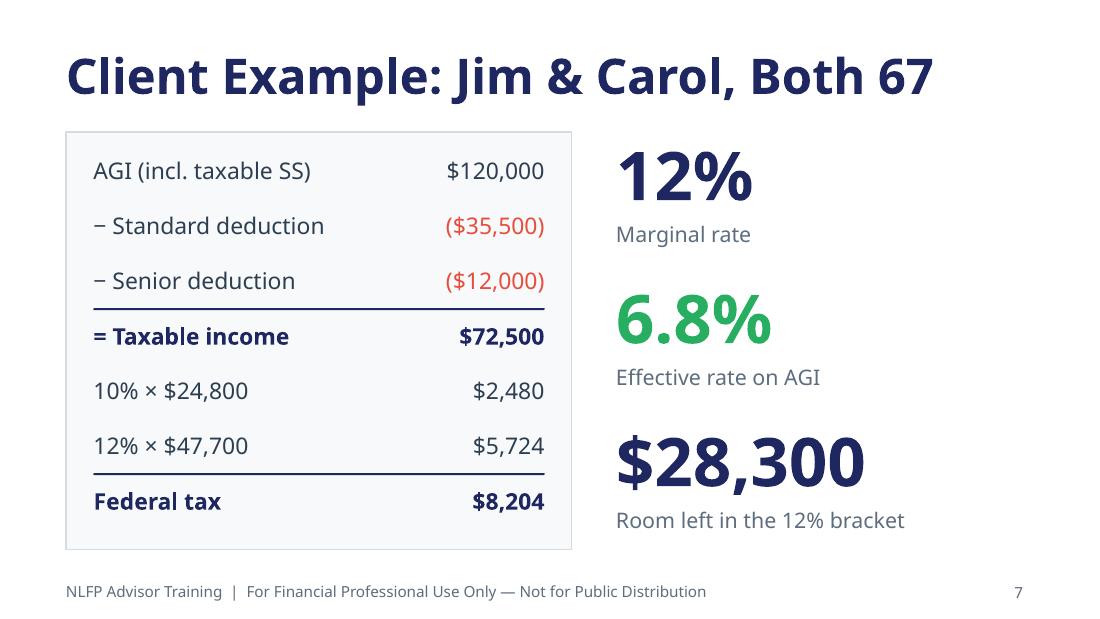
Hypothetical, MFJ, both 67, MAGI $120,000 — below the $150,000 phase-out, so the full $47,500 applies. Tax: $2,480 + $5,724 = $8,204; $8,204 / $120,000 = 6.8%. Bracket room: $100,800 − $72,500 = $28,300. Federal only; Florida has no state income tax, but clients in other states will.
Slide 8 of 13
Where the Planning Opportunity Is
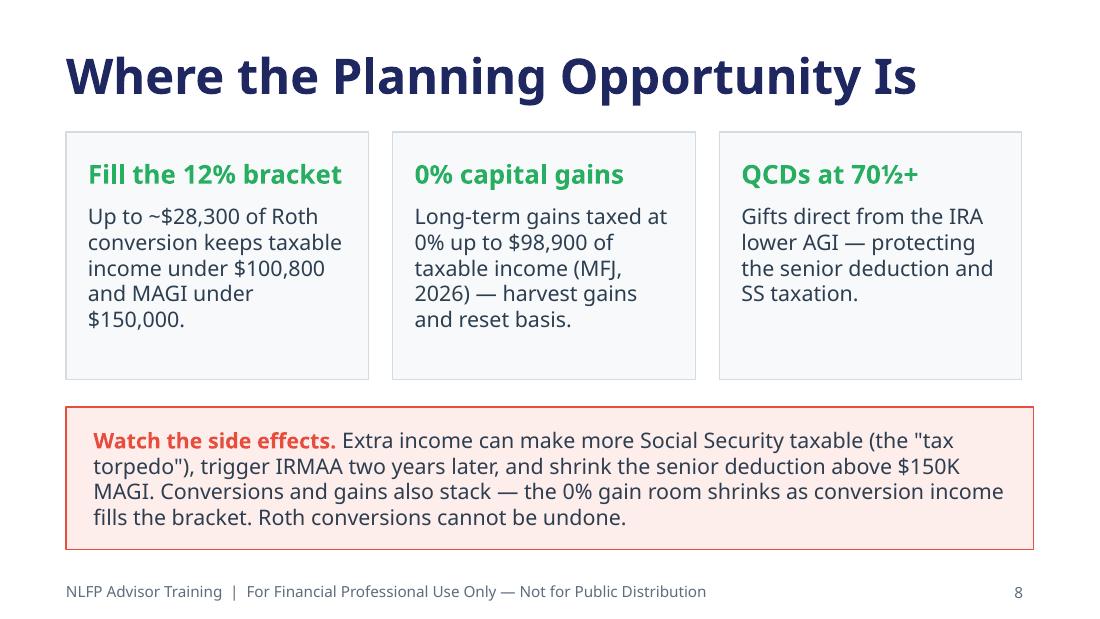
These are planning ideas to model and coordinate with the client's CPA — not recommendations to act. Ordinary income fills the brackets first, so a conversion pushes gains out of the 0% band. Run the projection with real numbers before any client conversation about amounts.
Slide 9 of 13
Tax Planning vs. Tax Advice
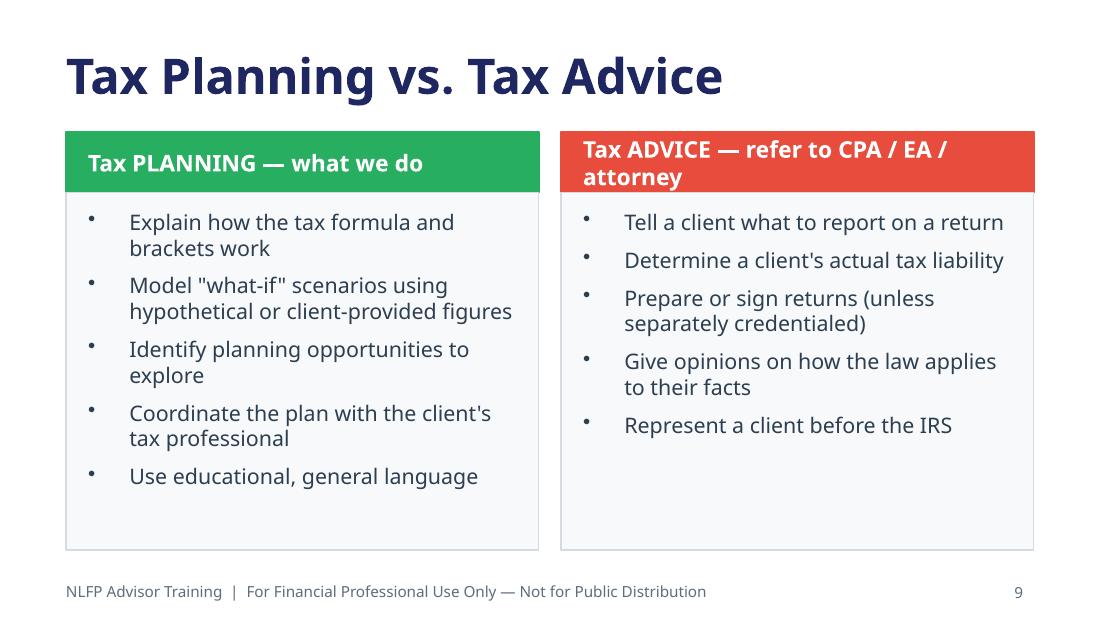
The line: planning is education and scenario modeling to support a financial plan; advice is a specific conclusion about how the tax law applies to a client's actual return. Unless you are a CPA, EA, or attorney acting in that capacity, stay on the left. Even then, confirm what your RIA and insurance carriers permit you to do under their agreements.
Slide 10 of 13
Advisor Scripts: Say This, Not That
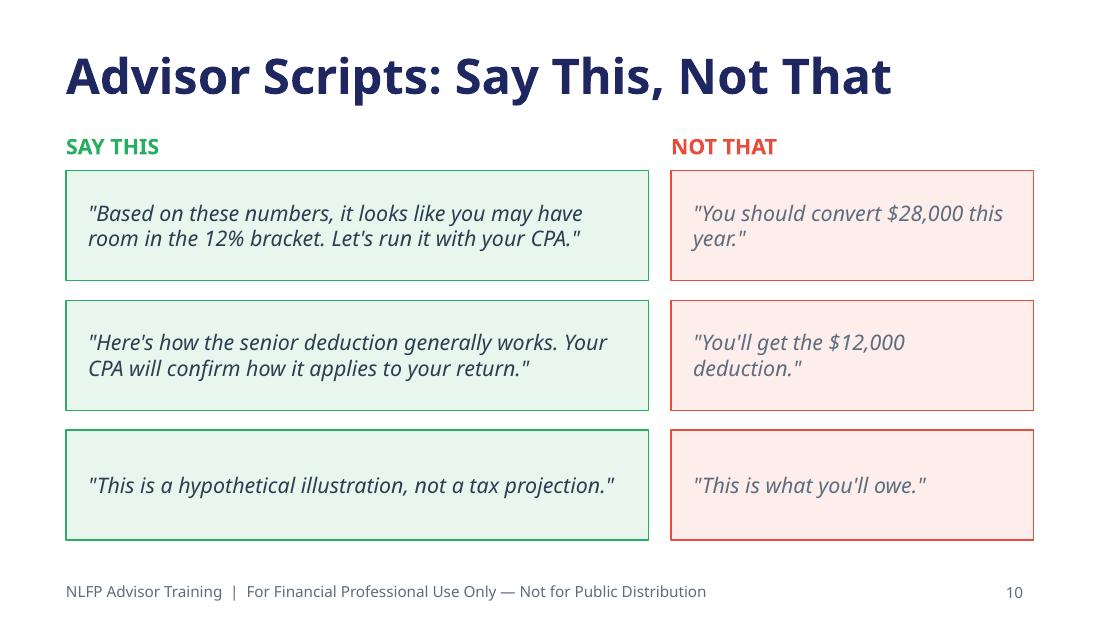
Role-play: pair advisors up. One plays Jim or Carol asking 'So how much should I convert?' The other answers using only left-column language and a CPA hand-off. Document the CPA referral in the CRM.
Slide 11 of 13
Common Mistakes and Action Steps
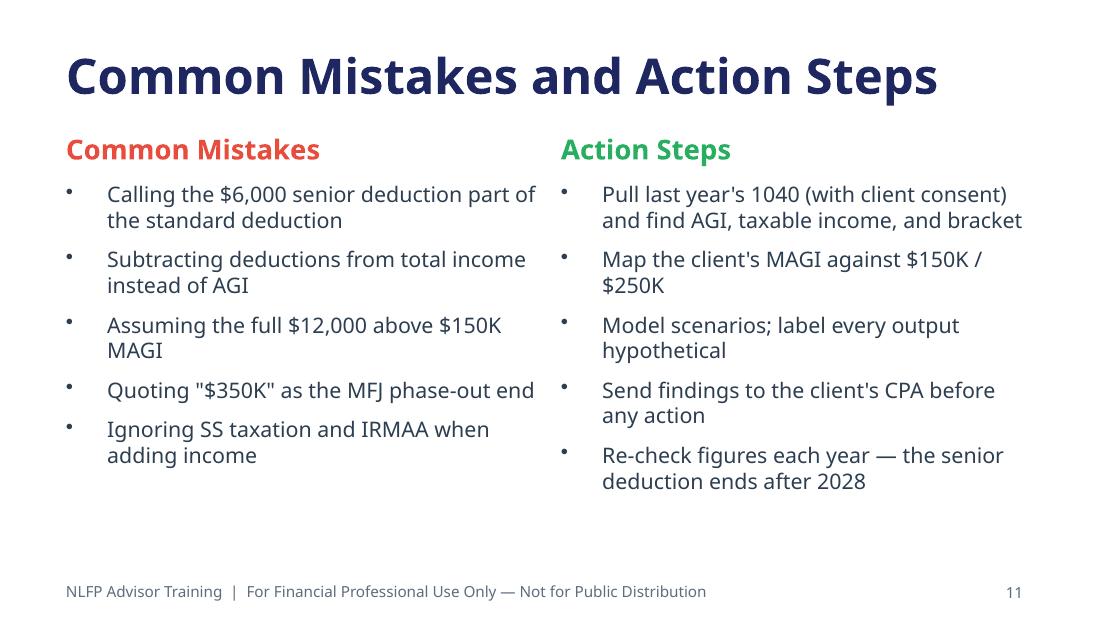
Close the teaching segment here before the knowledge check.
Slide 12 of 13
Knowledge Check
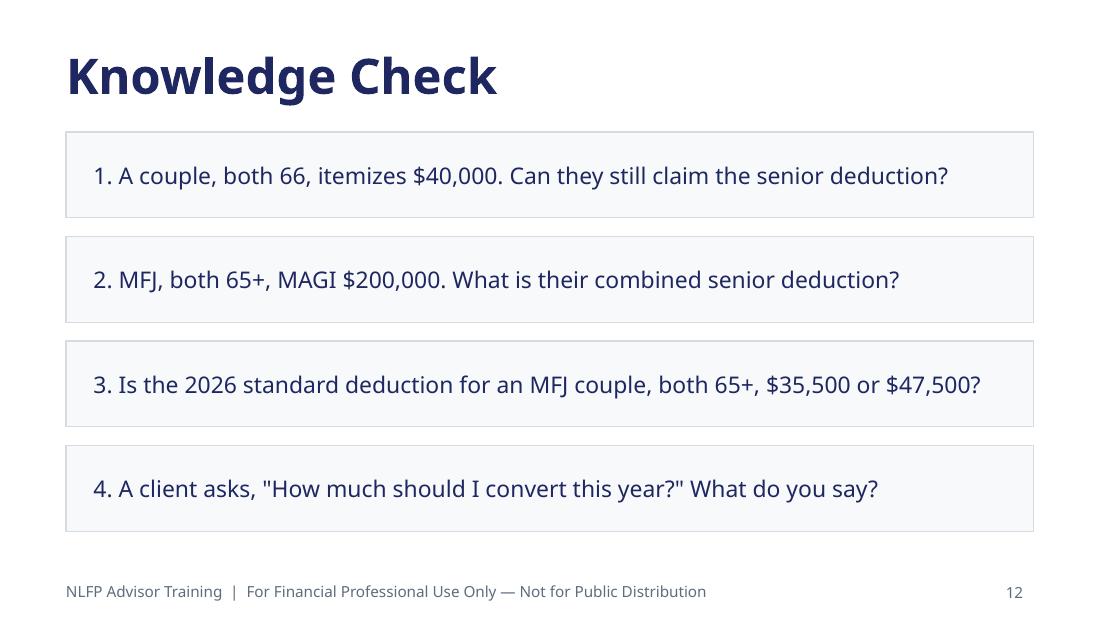
Answers: (1) Yes — the senior deduction is available to itemizers; they lose only the $1,650 age add-on. (2) $6,000 total: each spouse's $6,000 is reduced by 6% × $50,000 = $3,000, leaving $3,000 each. (3) $35,500 — the $12,000 senior deduction is a separate deduction, so total deductions can reach $47,500. (4) Explain the bracket room in general terms, show a labeled hypothetical, and coordinate the actual amount with their CPA.
Slide 13 of 13
Important Disclosures
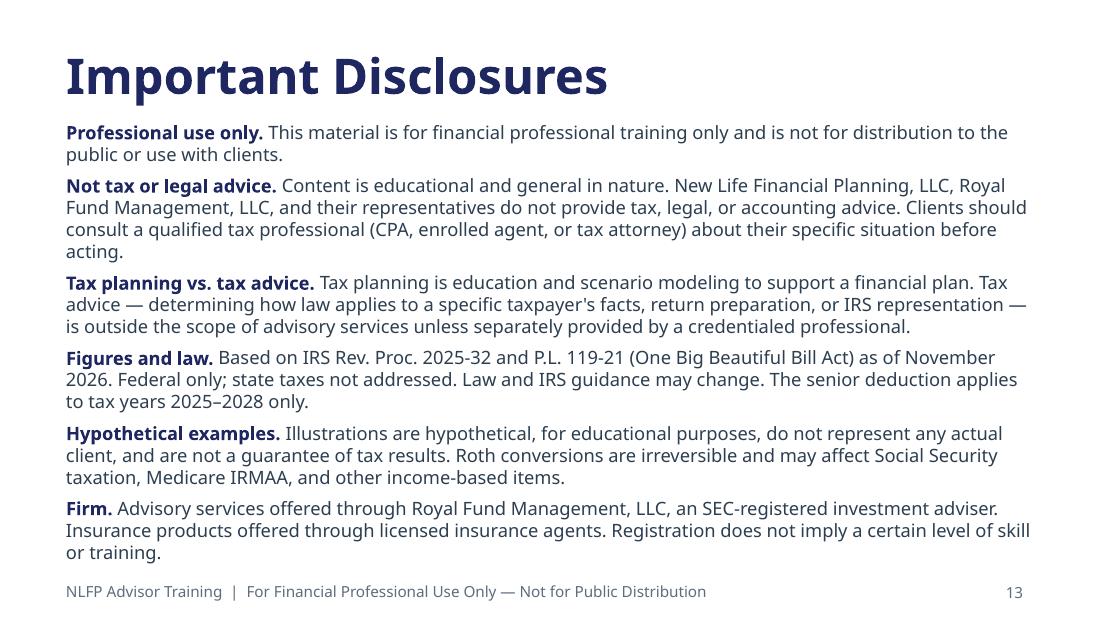
Confirm final wording with Royal Fund Management compliance before use; replace with firm-approved disclosure language if it differs. Do not adapt this deck for public seminars without a compliance review.
60-minute training agenda
| Time | Focus | Practice outcome |
|---|---|---|
| 0–10 minutes | Discover a personal goal and gain permission. | Choose one opener and one follow-up. |
| 10–25 minutes | Walk through the site using fictional numbers. | Explain default rate, report-request form and contact notice. |
| 25–40 minutes | Read model assumptions and practice examples. | Separate projected taxes, simplified comparisons and actual savings. |
| 40–55 minutes | Role-play interest, skepticism and objections. | Listen, respond without pressure and propose a relevant next step. |
| 55–60 minutes | Debrief and record a follow-up plan. | Name the question, owner and appointment—not a product. |
Site walkthrough: Calculate → Evaluate → Act
| Step | What to do on the site | What to say / check |
|---|---|---|
| 1. Before opening | Open retire-tax-bill.com. Read the disclosure and agree whether to use fictional or rounded figures. | “May I show you a rough illustration? We do not need statements or account numbers.” |
| 2. Your numbers: age | Enter Current age. Use a fictional age such as 60 for practice. The reviewed code accepts ages 18–89. | No joint-household age rule is identified on the input screen. Do not silently choose one spouse’s age as a complete joint projection. |
| 3. Your numbers: account value | Enter Current IRA or 401(k) value. The reviewed code accepts at least $1,000. | Use fully pretax assets for these demonstrations. Separate Roth, after-tax basis, brokerage and other accounts; they do not share identical tax treatment. |
| 4. Your numbers: rate | Average tax rate starts at 25%; the slider spans 15%–40%. The default-rate checkbox begins selected. | “This is an assumption, not your tax bracket.” For an alternative-rate practice run, deselect the default option and confirm the displayed rate before continuing. |
| 5. Continue | Select Continue to final step once the numbers are valid. Record age, balance, rate and included accounts. | The observed next screen says “Your analysis is ready. Tell us where to send it.” |
| 6. Where to send it | First name, last name and email are requested. Phone is optional. Change my numbers returns to the inputs. | Explain contact consent. Let the prospect decide; do not submit invented contact information or someone else’s details. |
| 7. Request the report | Only with informed permission, select See my report and read the actual confirmation, errors and delivery instructions. | Submission and email delivery were not tested. Do not promise an emailed PDF, delivery time or successful delivery. |
| 8. Evaluate the report | Read Potential tax impact and the two alternatives, checking assumptions and dollar units before interpreting totals. | “Which assumptions match your situation, and which need review?” Confirm that the report is through age 90, not a current bill. |
| 9. Act thoughtfully | Agree on a separate review of income, spending and suitable tax choices; use approved secure records. | “Would it be useful to compare your current approach with one or two alternatives?” The report is not an implementation instruction. |
The site’s three labels are “Your numbers,” “Where to send it” and “Your report.” This academy does not collect prospect details or submit the external form for you.
Read the report: what the model is actually comparing
| Source-reviewed label / assumption | Meaning in the model | Talking point / limitation |
|---|---|---|
| Potential tax impact · Keep qualified account | The projection runs from the entered age through age 90, including RMDs and an assumed tax on the remaining qualified-account balance at the end. | Not a current amount due or a personalized lifetime forecast. Confirm nominal versus discounted dollars. |
| Taxes paid on RMDs when withdrawn | Projected required withdrawals use a built-in Uniform Lifetime divisor table and estimated birth-year starting age, taxed at the chosen constant rate. | Check actual birth date, current RMD rules and the correct table. Spouse age, eligibility and account-specific rules can differ. |
| Taxes paid on reinvested RMDs | The model reinvests after-tax RMDs in a taxable account and applies tax to modeled growth there. | It does not assume those RMDs are spent on living costs. Actual spending and investment tax character can materially change this comparison. |
| Taxes on remaining account value at age 90 | The model applies the chosen rate to the remaining qualified balance. | This is an assumed end-horizon tax, not a requirement to liquidate everything at 90 or actual beneficiary tax. |
| Total taxes paid | Adds the modeled tax components under its assumptions. | A tax total alone does not show net wealth, spending, present value, fees or the best strategy. |
| Reposition to a tax-free account today | The simplified alternative uses current balance × chosen rate as its initial tax cost and assumes tax-free treatment afterward. | Do not equate this with a suitable Roth conversion or insurance product. Actual conversion brackets, tax funding, qualification, costs, liquidity, risk and product rules require separate analysis. |
| Growth and drag | The reviewed code sets 6% displayed growth and 1% annual drag, giving 5% modeled qualified-account growth before withdrawals. | Neither return nor drag is guaranteed. The 1% modeling assumption is not a quote of advisory or product fees. |
| Time value | The code also computes a today’s-dollar figure by discounting at its 5% modeled net growth rate. | Do not compare a nominal lifetime total with a discounted amount as if the units were the same; discounting at 5% is not an inflation guarantee. |
Report labels and model details were reviewed in publicly served calculator code, not a live submitted report. Confirm the current report and disclosures before presenting. Future income, state tax, deductions, variable tax brackets, Social Security, IRMAA, NIIT and real spending need household-specific analysis.
Opening questions that invite a real conversation
| Purpose | Ask the prospect | Natural follow-up |
|---|---|---|
| After-tax income | When you look at your retirement account, do you think about the balance or the monthly income it can provide after taxes? | Which amount have you been using to plan your spending? |
| Unexamined assumption | What tax rate have you assumed for retirement—and how did you arrive at it? | Would you be comfortable testing that assumption? |
| Existing planning | Has anyone shown you how IRA withdrawals, Social Security and other income could fit together? | What did that review include, and what still feels unclear? |
| Personal priority | What would more flexibility in retirement make possible for you? | Is travel, family support, predictable spending or leaving a legacy most important? |
| Withdrawal decision | How will you decide which account to draw from first? | Would seeing two sequences help you evaluate the trade-offs? |
| Surviving spouse | If one of you were living alone, how would the income and tax plan change? | Would you like that situation included without assuming the outcome? |
| Beneficiaries | Have you discussed what your children might receive after taxes and under the account’s beneficiary rules? | Would you want the tax professional to help examine that? |
| Current adviser | What retirement-tax questions would you like your current adviser or CPA to help answer? | We can coordinate rather than replace a relationship that works. |
| Permission | Would you be open to an assumption-based illustration—not a prediction of what you will owe? | We can start with fictional numbers and stop whenever you prefer. |
Curiosity hooks: connect the gap to their goal
| Hook | Question that keeps it conversational | Avoid the misleading version |
|---|---|---|
| An account balance and spendable income are different numbers. | Have you seen both numbers side by side? | “Your IRA is worth 25% less” as a universal valuation claim. |
| Tax-deferred means the tax decision may still be ahead of you. | When and from which accounts do you expect to take money? | “You have an unpaid IRS bill right now.” |
| The same balance can produce different after-tax outcomes under different assumptions. | Which assumptions would you want us to stress-test? | “This proves exactly what you will owe.” |
| A lower tax bill this year is not automatically a better lifetime plan. | Should we compare taxes, spending and family outcomes together? | “Every retiree should convert to Roth now.” |
| A useful next step can be a comparison—not a commitment. | Would you like to see keeping things unchanged beside an alternative? | “Act today before it is too late.” |
Hypothetical arithmetic: not the website’s age-90 report
| Practice case / assumed inputs | One-time balance × rate | Remaining after that assumed tax |
|---|---|---|
| Maria, 60: approaching retirement: $500,000 fully pretax; 25% assumed rate. | $125,000 assumed tax. | $375,000 in this simplified illustration. |
| David & Elaine, 65: comparing assumptions: $1,000,000 fully pretax; 20% assumed rate. | $200,000 assumed tax. | $800,000 in this simplified illustration. |
| David & Elaine: same balance, different assumption: $1,000,000 fully pretax; 30% assumed rate. | $300,000 assumed tax. | $700,000 in this simplified illustration. |
| Pat, 70: legacy and liquidity: $1,500,000 fully pretax; 25% assumed rate. | $375,000 assumed tax. | $1,125,000 in this simplified illustration. |
No growth, withdrawal schedule, time horizon, deductions, state tax, rate changes or tax interactions are modeled here. These figures are not withdrawal recommendations or lifetime totals. The $100,000 difference between the two $1 million cases comes only from changing the assumed rate; it is not proven savings and is not created by using the site.
Turn each example into a useful conversation
| Prospect | Talking point & question | Earn the next step |
|---|---|---|
| Maria, 60; $500,000 fully pretax | “At a hypothetical 25%, this simple arithmetic separates $125,000 assumed tax from $375,000 remaining. That is not a bill. What rate and spending assumptions have you planned around?” | Review monthly spending, retirement date, income sources, account basis and plausible future tax scenarios. |
| David & Elaine, 65; $1 million fully pretax | “At 20% versus 30%, assumed tax differs by $100,000. Changing a slider did not save anything. What would help decide which assumptions are reasonable?” | Compare an unchanged withdrawal plan with alternatives under the same assets, spending, returns, tax funding and costs; include both spouses. |
| Pat, 70; $1.5 million fully pretax | “At a hypothetical 25%, the simplified split is $375,000 and $1,125,000. Your children’s outcome depends on beneficiary rules and their facts. Is your priority lifetime income, family or charity?” | Coordinate beneficiaries, liquidity, income needs and tax/estate review. Do not treat the owner’s assumed rate as a child’s rate. |
Compelling talking points—with the necessary boundary
| Say it simply | Why it matters | Qualification |
|---|---|---|
| “You saved diligently. Now let’s look at how those dollars support your life after taxes.” | Affirms their effort and connects the account to a goal. | No claim that saving pretax was a mistake or Roth is always better. |
| “Tax-deferred is a timing benefit, not a promise of tax-free withdrawals.” | Raises awareness without a frightening tax-bomb claim. | Pretax withdrawals are generally ordinary income; Roth qualification, basis and other exclusions differ. |
| “Let’s separate what you know from what we are assuming.” | Turns a large number into a question worth checking. | Account balances may be known; future rates and spending are uncertain. |
| “The goal is a workable after-tax retirement—not just the smallest tax number.” | Keeps income, flexibility, costs and family priorities central. | Lower taxes can coexist with worse results if costs, risks or liquidity are ignored. |
| “A Roth conversion moves a tax decision; it does not make the tax disappear.” | Avoids an automatic conversion pitch. | Taxable conversions can create current income tax and other effects; compare no/smaller conversions and future rates. |
| “Tax planning should connect income, Medicare and family decisions.” | Shows why a review can add value beyond a calculator. | Social Security, NIIT and IRMAA use distinct income definitions; one average-rate input is insufficient. |
| “You do not have to change anything to learn where you stand.” | Makes analysis useful without pressure. | No transfer, insurance purchase or transaction is required to discuss assumptions. |
Respond to objections without pushing
| What the prospect says | Helpful response | Next question |
|---|---|---|
| “My CPA handles my taxes.” | “Great. These can be focused questions to review together, not a replacement for their advice.” | What future retirement-income choices have you already reviewed? |
| “I will be in a lower bracket.” | “That may be right. Let’s compare that expectation with other plausible income and deduction scenarios.” | What is included in that assumption? |
| “That number is scary.” | “It is based on assumptions—not a bill or a demand to act. We can pause.” | Would you rather check the assumptions first or leave this for another time? |
| “Should I convert everything?” | “No. The estimate cannot decide that. A conversion may help, hurt or be unnecessary.” | Would comparing no conversion, smaller conversions and another suitable option be useful? |
| “I do not want calls or to share information.” | “Understood. You can stop before submitting; the site says submission permits contact.” | Would a fictional example without a report request be preferable? |
| “What does the report cost?” | “The site advertises a no-cost report. Submission permits follow-up; separate services or products need their own cost and compensation discussion.” | Would you like to review the notice before deciding? |
| “I need to think about it.” | “Of course. There is no deadline created by this estimate.” | Would a short summary help, or would you prefer no follow-up? |
Before making a recommendation
| Review area | Facts to confirm | Do not assume |
|---|---|---|
| Household picture | Account types/basis, spending, pensions, Social Security, filing status, ages, state and deductions. | One account input describes the whole household. |
| Report assumptions | Horizon, growth, reinvested RMDs, end-horizon tax, discounted/nominal amounts and omitted costs. | A headline total is a current liability or proven savings. |
| Tax interactions | Separate ordinary tax, Social Security combined income, NIIT MAGI and IRMAA MAGI. | Up to 85% of benefits taxable means an 85% rate; a Roth conversion itself is net investment income. |
| Conversions and RMDs | Compare no/smaller/larger suitable conversions, consistent assets/spending/returns and tax funding. | The calculator proves Roth savings; required minimum distributions can be converted. |
| Medicare timing | IRMAA usually uses income two years earlier; confirm the premium-year schedule. | A taxable 2026 conversion uses 2026 thresholds for 2028 premiums. |
| Legacy and charity | Survivor/beneficiary facts, trust terms where relevant, charitable goals and separate tax rules. | An heir has the owner’s rate/withdrawal rules; a pretax IRA gets a basis reset like typical inherited capital assets. |
| Implementation and privacy | Tax-professional review, firm approval, liquidity, fees, risks, consent and secure records. | Submitting a form approves a product purchase or account transfer. |
Why it matters for advisers
- ◆A concrete question about spendable income is more useful than a generic pitch about saving taxes.
- ◆Explaining uncertainty and the contact/compensation boundaries earns trust without relying on a large number to create urgency.
- ◆Use the same structure in person, on a screen-share or in an approved follow-up message; keep private documents off public pages.
Practical takeaways
Ask → pause → listen
- Use one opener and a follow-up tied to their answer.
- Reflect: “It sounds like predictable income matters most.”
“What would you want this review to help you feel clearer about?”
Separate estimate from plan
- Label default rates and hypothetical arithmetic.
- Record unknowns and confirm actual report assumptions.
“This gives us questions to investigate—not a conclusion about what you owe.”
Respect the submission decision
- Explain contact consent and optional phone.
- Stop before submitting if the prospect does not want contact.
“We can learn from an example without requesting a report.”
Close on a useful question
- Agree on scope, participants and date.
- Coordinate with the existing CPA/adviser; accept a no.
“Would comparing two withdrawal scenarios help answer your income question?”
Scripts to use with clients
“30-second opener: You have worked hard to build your retirement savings. When you look at that balance, have you considered what it could provide after taxes? If you are open to it, we can use an illustration to identify assumptions worth checking—not predict your tax bill.”
“Permission bridge: May I open retire-tax-bill.com with fictional numbers? It asks for age, an IRA or 401(k) balance and an assumed average tax rate. You can decide separately whether you want a report and follow-up contact.”
“Rate explanation: The site starts at 25%. That is a default—not a finding about you or necessarily your marginal bracket. Let’s label it as an assumption and ask your tax professional which scenarios are reasonable.”
“Contact-form explanation: The report request asks for first and last name and email; phone is optional. The notice permits New Life Financial Planning contact about results; the disclosure notes possible insurance-agent contact and commissions. Do not enter account or Social Security numbers. Would you like to continue or stop here?”
“Report debrief: Before drawing a conclusion, let’s read the assumptions. The model includes RMDs reinvested rather than spent and an assumed tax on the account remaining at age 90. What surprises you? Would your real spending or tax situation change the comparison?”
“Existing-adviser bridge: If your adviser or CPA already has a plan, that is valuable. We can use these questions to evaluate it together rather than assume something is missing.”
“Appointment invitation: You said maintaining monthly income is your main concern. Would a 20–30-minute review comparing your current withdrawal approach with one alternative be useful? We can include your spouse and tax professional and agree on a secure information-sharing process. No commitment to change anything.”
“Approved email/text draft: Hi [first name], you mentioned wanting clarity about retirement income after taxes. Here is the illustration site we discussed: https://retire-tax-bill.com/. It uses assumptions, not a prediction of your actual bill; requesting the no-cost report permits follow-up contact. If useful, we can review the assumptions together. If not, no problem. [Adviser name / firm-approved contact and disclosures]. Send only under your firm’s consent, privacy and marketing rules.”
Team discussion questions
- Triads: rotate adviser, prospect and observer through three 5-minute conversations, then debrief for 5 minutes. Use Maria, David & Elaine or Pat; all numbers and identities are fictional.
- Observer checklist: permission, listening, default named as an assumption, contact consent explained, projection separated from liability, no guarantees and a specific optional next step.
- Prospect challenge: say “My CPA handles this,” then “I do not want calls.” Coordinate with the CPA and stop before submission without arguing.
- Accuracy challenge: explain why changing 20% to 30% on $1 million creates a $100,000 illustrative difference but proves neither a strategy nor savings.
- Each adviser writes an opener, one curiosity follow-up, a 60-second example explanation and an appointment invitation tied to the stated goal.
- Record goal, agreed question, assumptions/unknowns, contact preference, participating professionals and next date. Request private documents only through approved secure channels.
References & planning safeguards
Reviewed November 2, 2026. Educational material for financial professionals—not individualized legal, tax or benefits advice. Confirm current law, program limits and state-specific rules before implementation with qualified professionals.
- Retire Tax Bill — live input and contact steps; report assumptions reviewed in public calculator code
- IRS Publication 590-B — IRA distributions, Roth qualification and RMDs
- IRS — Net Investment Income Tax questions and answers
- IRS Publication 915 — Social Security benefit taxation
- Social Security — Medicare premiums and income-related adjustments
Continue learning
- Verbal Technology & Curiosity SellingHow to pique interest without sounding salesy
- Retirement Withdrawal Strategies: Look Beyond This Year’s TaxCompare four withdrawal scenarios and the income interactions that can change their after-tax results.
- The 10 Retirement Surprises and the NIIT ConnectionAn adviser review of withdrawals, Social Security, Medicare, care costs, survivor income and inheritance
- Power Phrases & Pattern InterruptersListen first, reframe with care, and help the client choose a useful next step.
Your next step
Practice this conversation with us live
Join Bryan Daly, CFP®, RICP® and other agents and advisors for live, interactive training. Every Saturday · 10 a.m. Eastern. Client first. Strategy before product.
For agents’ and advisors’ professional training only. Requests are reviewed before access details are shared.